Laser Veneer Removal at Basmat Al Hayat Medical Center
Dental veneers may need to be removed when a veneer chips or cracks, the appearance of the smile needs to be redesigned, decay or inflammation develops around a restoration, or an older set is due to be replaced. At that point, the important question is not simply how to take the veneer off. The dentist must consider how to separate the restoration while preserving as much of the underlying tooth structure as possible, examine what is beneath it, and prepare a safe plan for protecting or restoring the tooth after removal.
Laser-assisted veneer removal is a conservative option for selected cases. An erbium dental laser can transmit energy through certain ceramic veneers and interact with the resin cement at the bonding interface. This may weaken the bond so the dentist can separate the veneer with less mechanical cutting or force than would otherwise be required. It does not mean that every veneer will “pop off,” that all materials respond in the same way, or that rotary instruments will never be needed.
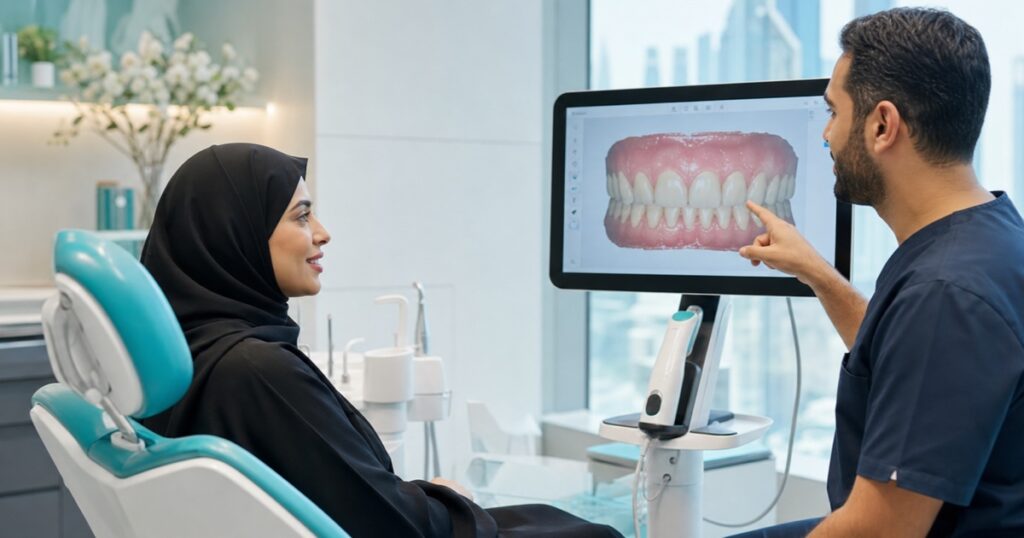
At Basmat Al Hayat Medical Center, the process begins with a clinical examination and, when indicated, photographs, digital scans, or dental X-rays. The dentist reviews the veneer material, thickness, translucency, margins, previous tooth preparation, gum health, bite, and the reason for removal. The final approach may use the laser as the main debonding method or combine it with magnification and precise mechanical instruments. Patients in Sharjah and Ras Al Khaimah can book an assessment, and the booking team will confirm the suitable branch, dentist, and equipment for the planned procedure.
What Is Laser Veneer Removal?
Laser veneer removal, also called laser-assisted veneer debonding, is a technique used to help separate some bonded veneers from teeth. Erbium lasers such as Er:YAG may be used when the veneer material and clinical conditions allow sufficient energy transmission. The energy passes through the restoration to varying degrees and interacts with water and components within the resin cement. This disrupts or weakens the adhesive interface, after which the dentist tests the veneer margins and attempts controlled separation.
The purpose is not to burn the ceramic or heat the tooth. Clinical use relies on controlled pulses, appropriate power and frequency, continuous movement, air-water cooling, protective eyewear, and careful observation of how the restoration responds. A thin and translucent lithium disilicate veneer does not necessarily behave like a thick, opaque restoration. Even veneers on adjacent teeth may have different bonding areas or cement thicknesses, so the dentist adjusts the method tooth by tooth.
Laboratory studies, reviews, and clinical reports suggest that erbium lasers can help debond lithium disilicate, feldspathic ceramic, and selected composite veneers. Research also shows that debonding time and temperature changes can be affected by veneer thickness, translucency, laser settings, and the cement used. Much of the evidence remains laboratory-based or comes from clinical reports, so the treatment should be described as a useful option for selected cases rather than a guaranteed method for every veneer.
Why Might a Veneer Need to Be Removed?
Veneers do not need removal simply because a fixed number of years has passed. A stable veneer with healthy margins, a comfortable bite, and an acceptable appearance may continue to function. Removal is discussed when there is a clinical or cosmetic reason that cannot be managed adequately while the restoration remains in place.
- A veneer is fractured, chipped, loose, or repeatedly debonds.
- Decay or leakage is suspected at the margin or beneath the veneer.
- The gums remain inflamed or bleed around bulky, rough, or poorly positioned margins.
- One or more veneers have changed colour or no longer match neighbouring teeth.
- The patient wants a new smile design because of unsatisfactory length, shape, shade, or symmetry.
- A tooth has pain, sensitivity, or another condition that requires access for treatment.
- The bite places excessive stress on the veneers or contributes to repeated cracking.
- Older restorations need replacement as part of a wider restorative plan.
Removal is not always the first recommendation. A dentist may be able to polish a rough edge, repair a small defect with composite, adjust a heavy bite contact, improve cleaning, or treat local gum inflammation. In other cases, keeping the veneer would hide or worsen the underlying problem. The examination balances the value of retaining the existing restoration against the need to diagnose and treat the tooth properly.
Is Laser Removal Suitable for Every Type of Veneer?
No. The term “veneer” includes different materials and construction methods. Glass ceramics such as lithium disilicate and feldspathic porcelain can transmit erbium laser energy to different degrees and may be suitable for laser-assisted debonding. The response varies with opacity, shade, thickness, surface treatment, and cement composition. A 0.5 mm translucent veneer may allow different energy transmission from a 1.0 mm low-translucency veneer.
Zirconia has different optical and material properties from glass ceramic. More opaque or thicker restorations may transmit less energy, take longer, or be unsuitable for complete laser debonding. Full crowns also differ from veneers because they surround a larger part of the tooth, have greater thickness, and follow a different path of removal. A dentist should identify whether the restoration is a laminate veneer, an occlusal veneer, a partial coverage restoration, or a crown before recommending a technique.
Direct composite veneers are built on the tooth in layers and may not exist as one separate shell that can be lifted off. Laser energy can be part of a conservative removal plan in selected composite cases, but the dentist may also need magnification, visual contrast, and fine instruments to distinguish composite from enamel. This is why a social-media video of one ceramic veneer separating intact cannot predict how another material will behave.
Laser-Assisted Removal Compared with Conventional Removal
Conventional veneer removal usually involves fine rotary instruments that cut or section the ceramic and gradually remove it. The dentist may work under magnification and use visual or optical cues to tell porcelain, cement, enamel, and dentine apart. This established method remains important and may be the most controlled option for certain materials. Its challenge is that restorative layers can have similar colours, requiring careful technique to avoid unnecessary removal of tooth structure.
Laser-assisted removal aims to weaken the adhesive layer before separation. In a suitable case, this can reduce drilling, vibration, and the amount of mechanical force applied to the restoration. Some veneers may separate intact. However, keeping the veneer in one piece does not automatically mean it is appropriate to reuse. It may be cracked, worn, contaminated, poorly fitting, or inconsistent with the new treatment plan. The internal surface and the remaining cement must still be examined and managed.
The choice is not simply modern technology versus an older technique. A dentist may use the laser first, then employ a fine instrument for a resistant margin. In another case, mechanical sectioning may be selected from the beginning because the ceramic does not transmit enough laser energy. Success is measured by safe diagnosis, controlled removal, and protection of the tooth—not by using one device in every situation.
How Is a Laser Veneer Removal Appointment Performed?
1. Examination and Diagnosis
The dentist asks when the veneers were placed, why they were placed, whether any have been repaired or re-bonded, and what symptoms or concerns are present. The gums, margins, teeth, and bite are examined. Photographs, measurements, digital scans, and X-rays may be used when they add useful information about decay, existing fillings, roots, bone, or treatment planning. If the patient has records that identify the ceramic or cement, bringing them may help, although treatment can still be assessed without them.
2. Planning What Happens After Removal
It is important to decide how the teeth will be protected before removing a large set of veneers. The goal may be to treat decay, replace one veneer, redesign several restorations, or assess whether another option is possible. Teeth that were prepared previously may require temporary veneers immediately after removal. The dentist therefore plans temporary restorations, scans or impressions, laboratory timing, colour selection, and any gum treatment in advance.
3. Protection and Comfort
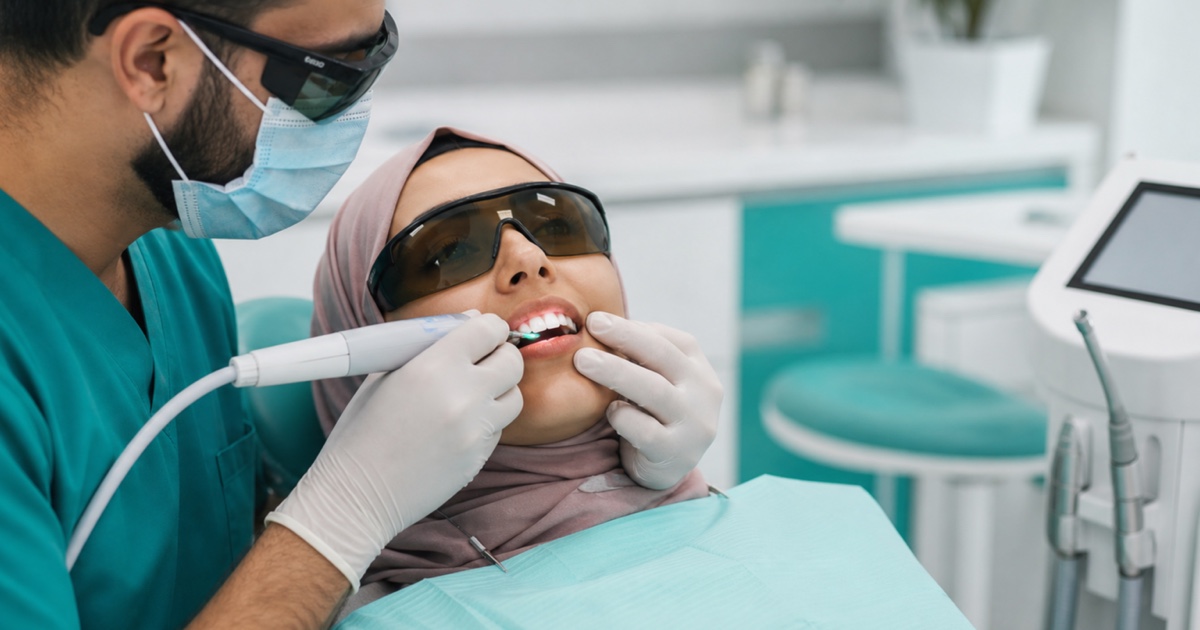
The clinical team uses the protective measures required for dental laser treatment, including suitable eyewear and controlled access to the treatment area. Local anaesthesia may be recommended depending on tooth sensitivity, the number of veneers, and any additional treatment planned. The presence of a laser does not mean that every patient will need no anaesthesia; comfort is managed according to the individual case.
4. Controlled Laser Application
The dentist moves the laser handpiece across the veneer in an organised pattern with the selected pulse settings and cooling. The aim is to distribute energy rather than hold it continuously over one point. Margins and movement are checked at intervals. Application time can vary between teeth because the thickness, cement, bonded surface area, and restoration material may not be identical.
5. Gentle Separation and Cement Removal
When the bond has weakened, a thin instrument may be used to test whether the veneer can be separated without excessive force. A resistant restoration should not simply be pulled harder. The dentist may apply further laser energy, adjust the approach, or use a controlled mechanical method. After removal, the tooth is inspected and residual cement is removed carefully. This stage may reveal decay, old composite, a crack, or previous preparation that was not fully visible beforehand.
6. Treatment or Temporary Protection
Depending on the findings, the next step may include treating decay, replacing a filling, managing gum inflammation, taking a new scan, or placing a temporary veneer. Some treatment plans can move directly into preparation for new restorations, while others need time for the gums or teeth to stabilise before the final impression or scan.
Does Laser Veneer Removal Preserve Natural Teeth?
The purpose of laser-assisted debonding is to reduce unnecessary mechanical cutting and preserve the tooth structure that remains. Laboratory studies have shown debonding with residual cement left on the tooth and without visible enamel ablation under specific testing conditions. These findings support a conservative approach, but they should not be turned into an absolute promise for every patient.
The appearance and condition of the tooth after removal are strongly influenced by what happened when the original veneer was placed. If enamel was removed during preparation, a laser cannot grow that enamel back. If decay or a crack has developed beneath the veneer, that condition still needs treatment. A no-preparation veneer and a heavily prepared tooth may look very different after their restorations are removed.
Before removal, photographs and X-rays can provide useful clues but cannot reveal every detail under an opaque bonded restoration. The dentist should discuss possible outcomes, including the need for a filling, root canal treatment, a new veneer, or a crown when the remaining tooth is too weak for a laminate. The realistic goal is to minimise avoidable tissue removal while treating the disease or restorative problem properly.
Is Laser Veneer Removal Painful?
Patients may notice less vibration and noise than during conventional drilling. They may feel mild warmth, pressure when movement is tested, or sensitivity depending on the tooth. Local anaesthesia can be used when needed, particularly if the teeth are already sensitive or if decay treatment, cement removal, or preparation for new restorations is planned during the same visit.
Comfort varies from one patient to another. Dental anxiety, the number of veneers, gum inflammation, and the condition of the underlying teeth all influence the experience. Patients should tell the dentist about previous difficult treatment or sensitivity so the appointment can be planned appropriately.
How Long Does Veneer Removal Take?
There is no single treatment time. Laboratory studies sometimes report short debonding times for standardised samples, but those figures should not be used as a promise for a clinical appointment. A thin translucent veneer may respond faster than a thicker or more opaque restoration, and removing one veneer is not the same as managing a full smile.
The appointment also includes examination, protection, cement removal, treatment of any underlying problem, digital scanning, and temporary restorations when required. After the assessment, the dentist can provide a more useful estimate of appointment length and the likely number of visits.
What Happens After Veneers Are Removed?
Each tooth is assessed separately after the veneer has been removed. The next step may include one or more of the following:
- Removing remaining resin cement and polishing the surface.
- Treating decay or replacing an older filling.
- Managing gum inflammation before taking final measurements.
- Placing a temporary veneer to protect a prepared tooth.
- Designing and placing new porcelain veneers.
- Using a conservative composite restoration when suitable.
- Selecting a crown if the amount of remaining tooth structure does not support another veneer.
- Providing root canal treatment only when diagnosis shows that the pulp is affected.
Patients often ask whether their teeth can be left without veneers. The answer depends on how much enamel was removed originally, the shape and strength of the teeth, and whether sensitivity or exposed dentine is present. Some minimal-preparation cases may be closer to the original tooth shape, but many veneer procedures permanently alter the enamel. A dentist cannot answer this accurately from a photograph alone.
Risks and Limitations
Every technique for removing a bonded restoration has limitations. The veneer may fracture during separation, and preserving it may be impossible or clinically unnecessary. Rotary instruments may still be needed for resistant areas or for cleaning cement. Temporary sensitivity can develop after the tooth surface is exposed, and inflamed gums may require time and treatment before new restorations can be made.
Heat must be managed with appropriate settings, cooling, movement, and treatment time because an excessive increase in pulpal temperature is undesirable. Protective eyewear and a trained clinical team are essential. Some materials or thick restorations may not allow predictable transmission of laser energy. The dentist should change or stop the approach if the restoration does not respond safely.
The condition beneath the veneer can also alter the plan. Deep decay, a crack, a large existing filling, or major loss of tooth structure may require a different restoration from the one originally discussed. This is not necessarily a failure of laser removal; it is a consequence of diagnosing a problem that was hidden beneath the veneer.
Preparing for Your Assessment
- Tell the dentist when and where the veneers were placed and whether they have been repaired.
- Bring records, material information, or older photographs if available.
- Describe pain, sensitivity, odour, gum bleeding, movement, or changes in appearance.
- Explain what you want to change about the smile rather than asking only for removal.
- Share your medical history, medications, allergies, pregnancy, and previous reactions to dental treatment.
- Ask how the teeth will be protected between removal and the final restorations.
Healthy gums make diagnosis, scanning, and new veneer margins more predictable. If there is heavy calculus or bleeding, the dentist may recommend professional teeth cleaning and gum care before the cosmetic phase.
Care After Veneer Removal
Aftercare depends on what was done during the appointment. If temporary veneers are fitted, avoid very hard or sticky foods on the treated teeth and do not use the front teeth to open packages or bite ice. Clean gently and follow the team’s instructions for flossing around temporary restorations. Mild sensitivity to cold or air may occur for a short time.
Contact the clinic if a temporary veneer becomes loose, pain increases, swelling appears, or the bite feels very high. Do not delay the final restoration appointment when prepared teeth are protected by temporary veneers. Patients who clench or grind may need a night guard after the final restorations have been fitted.
Planning the New Smile
If the goal is veneer replacement, the dentist reassesses tooth colour, gum health, lip movement, tooth proportions, smile line, and bite. Not every tooth automatically needs another veneer. A conservative plan may use fewer restorations or combine whitening, composite, and ceramic where appropriate. The Porcelain Veneers service page explains the role of new veneers, but material, shade, and tooth selection require an individual examination.
A natural smile design is not simply the lightest shade. It considers length-to-width proportions, edge translucency, tooth display during speech, gum symmetry, and daily cleaning. The reason the old veneers failed should also be addressed. Bite problems, grinding, decay risk, bulky margins, or difficult cleaning can shorten the life of new restorations if they are ignored.
Laser Veneer Removal Cost
There is no single fee for every case. Cost depends on the number of veneers, material and thickness, access to the margins, the need for X-rays or anaesthesia, temporary restorations, and treatment required after removal. Removing one damaged veneer is different from removing a complete set as part of a new smile design.
The clearest estimate is provided after an examination and treatment plan. The plan can separate the removal phase, underlying dental treatment, temporary protection, and final restorations. Patients can use the Appointments page or WhatsApp to request an assessment and mention the approximate number of veneers and the reason for considering removal.
Why Choose Basmat Al Hayat Medical Center?
Evaluation at Basmat Al Hayat Medical Center considers cosmetic dentistry, tooth health, gum condition, and the bite together. The dentist investigates why a veneer has failed, explains the limitations of laser treatment, and plans how each tooth will be protected or restored. Access to dental examination, imaging, gum care, restorative dentistry, and cosmetic services allows the treatment stages to be coordinated.
Basmat Al Hayat Medical Center serves patients through branches in Sharjah and Ras Al Khaimah. Visit Our Doctors or contact the booking team to select the appropriate branch. Suitability for laser-assisted removal is confirmed only after examination, and another method may be recommended when it offers better control for the restoration material or tooth condition.
Book a Laser Veneer Removal Assessment
If you have old, damaged, loose, or uncomfortable veneers, or you are planning to replace a previous smile design, book a dental assessment at Basmat Al Hayat Medical Center. Bring any information about the veneer material if available and explain both the problem and the result you hope to achieve. After examination, the dentist will discuss whether laser-assisted removal is suitable, what alternatives are available, how the teeth will be protected, and the estimated treatment stages and cost.
Laser Veneer Removal FAQ
Can veneers be removed with a laser without drilling?
The laser may reduce the need to drill through a veneer when energy can pass through the material and weaken the cement. Some cases still require fine instruments or controlled sectioning. The result depends on material, thickness, translucency, cement, and previous preparation.
Will my teeth return to their original shape after veneer removal?
That depends on how much tooth structure was removed before the veneers were placed. Laser removal cannot replace enamel that was prepared previously. The teeth may need new veneers or another protective restoration.
Can an intact veneer be reused?
Separating a veneer in one piece does not automatically make it suitable for re-bonding. The dentist checks cracks, margins, internal surface, fit, the reason for removal, and whether it suits the new plan. Replacement is preferable in many cases.
Can zirconia veneers be removed with a laser?
Zirconia behaves differently from glass ceramics because energy transmission is affected by its composition, opacity, and thickness. Laser-only removal may not be predictable. The dentist selects laser, mechanical removal, or a combined method after identifying the restoration.
Does laser veneer removal hurt?
There may be less vibration and drilling noise, while local anaesthesia can be used when needed. Comfort varies with sensitivity, the number of veneers, and any additional treatment performed during the appointment.
How long does laser veneer removal take?
There is no fixed duration. Thin translucent veneers may respond faster in some studies, while thick or opaque restorations can take longer or require a combined technique. Treatment time also includes cement removal and temporary protection.
Can new veneers be placed on the same day?
Some treatment stages can occur in the same visit, but final ceramic veneers usually require planning, a scan or impression, laboratory fabrication, and a fitting appointment. Decay or gum inflammation may need treatment first, and temporary veneers can protect prepared teeth.
Can veneer removal cause sensitivity?
Temporary sensitivity may occur when the tooth surface is exposed, especially if the original preparation removed significant enamel. Severe or persistent pain needs assessment to exclude deep decay, a crack, or a pulp problem.
When is laser not the best removal method?
Laser may not be the best option when the material or thickness does not transmit sufficient energy, the restoration is fractured in a way that requires sectioning, or mechanical removal gives the dentist greater control. Tooth safety and the complete treatment plan take priority over using the laser.
Medical References
- Efficiency of Er:YAG laser in debonding porcelain laminate veneers.
- Laser-aided ceramic restoration removal: a comprehensive review.
- Effect of laser power and veneer thickness on debonding time and pulpal temperature.
- Narrative review and clinical study on Er:YAG laser debonding.
This page provides general information and does not replace a dental examination. Suitability for laser-assisted removal and the treatment plan vary according to the veneer material and the condition of the teeth and gums.