
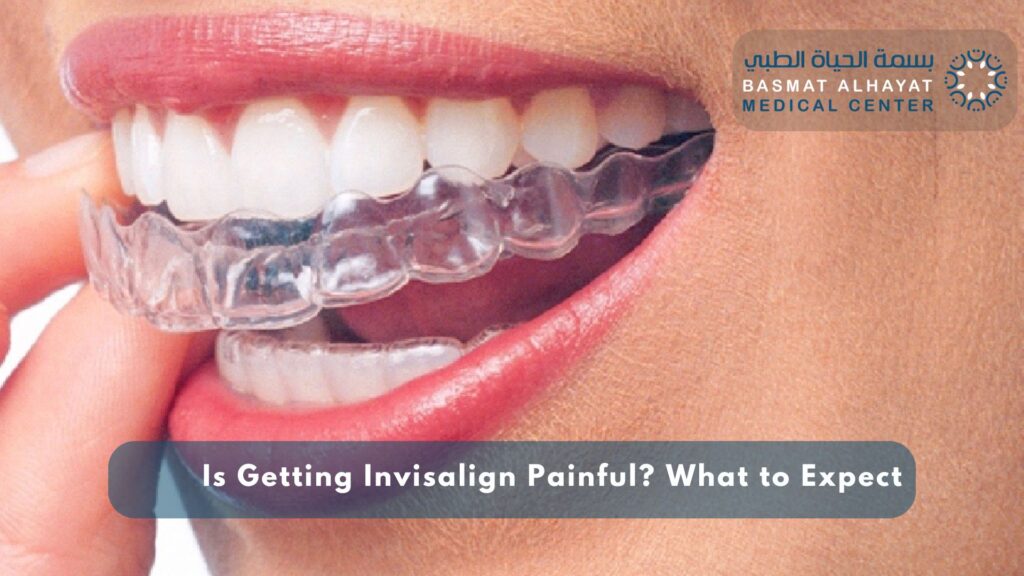
If you are researching Invisalign in Sharjah or Ras Al Khaimah, one of the first questions is: does it hurt? The honest answer is that Invisalign is not painful in the way most people fear — but it is not completely sensation-free either. There is an important distinction between pain and discomfort, and understanding it will completely change how you approach your treatment at Basmat Al Hayat Medical Center.
How Invisalign Works
Invisalign uses a series of custom-made, BPA-free clear plastic aligners that progressively shift teeth into their ideal positions. Each aligner is designed to be slightly different from your current tooth position, creating gentle, controlled pressure that nudges teeth toward their target. You switch to a new aligner every 1–2 weeks, and with each new tray, the cycle of mild pressure begins again for a few days before it fades.
Is Invisalign Painful? What Patients Report
Clinical data and patient feedback consistently show that the vast majority of Invisalign wearers experience pressure and tightness — not sharp pain. Patients commonly describe the sensation as:
- A tightness similar to the feeling after a professional dental cleaning.
- A slight sense that the tray is snug and requires a little effort to remove at first.
- Mild tooth sensitivity when biting on harder foods during the first day or two.
This discomfort typically peaks within the first 24 to 72 hours of a new aligner, then fades steadily until you are ready to switch to the next tray.
When Is Discomfort Most Likely?
First Aligners
The very first aligner may feel strange simply because the mouth is not used to having something over the teeth. The actual pressure is usually minimal. The adjustment is more psychological than physical.
Mid-Treatment Aligners
This is often when the most significant tooth movements happen: rotations, vertical corrections, and bite adjustments. Your orthodontist at Basmat Al Hayat will monitor progress at each check-up.
After Attachments Are Added
Attachments are small tooth-colored dots bonded to certain teeth to help aligners grip and guide more complex movements. After placement, some patients notice increased pressure as the aligners now have more surface area to apply force from.
Invisalign vs. Traditional Braces: Which Hurts More?
The evidence is fairly clear: Invisalign is generally more comfortable than metal braces for most patients.
- No metal wires to tighten monthly — tightening appointments with traditional braces often cause soreness lasting 3–5 days.
- No sharp brackets or wires rubbing against the inside of the cheeks and lips.
- Removable design means teeth and gums get a break during meals and brushing.
- Gentler, more distributed forces across the tooth surface rather than concentrated point-pressure from brackets.
Practical Tips to Manage Discomfort
Time Your Tray Changes Strategically
Switch to a new aligner right before bed. You will sleep through the first few hours when pressure is highest, and wake up with teeth already adjusting.
Use Your Chewies
Chewies are small cylindrical foam rolls you bite down on for a few minutes after inserting a new aligner. They help seat the tray fully against teeth, reducing uneven pressure.
Over-the-Counter Pain Relief
Ibuprofen or paracetamol in standard doses can take the edge off during the first couple of days of a new tray. Always follow dosage guidelines and consult your doctor if you take other medications.
Soft Foods Temporarily
Choose softer foods during the first day or two of a new aligner. Yogurt, soup, soft pasta, and smoothies are great options that avoid putting pressure on sensitive teeth.
Your First Week with Invisalign
- Day 1: Strange sensation in the mouth. Slight speech lisp on “s” sounds. Completely normal and temporary.
- Days 2–3: Peak pressure. Most patients describe it as manageable tightness, not sharp pain.
- Days 4–5: Discomfort begins to fade noticeably.
- Days 6–7+: The aligner feels comfortable — a sign it is working and the next tray is approaching.
When to Call Your Orthodontist
While mild discomfort is normal, some signs warrant a call to the Basmat Al Hayat team:
- Sharp, persistent pain lasting more than 5 days after a new aligner.
- Pain in the jaw joint or temples, which could indicate bite issues.
- Sores or ulcers in the mouth that do not improve after a week.
- An aligner that does not fully seat over teeth even after using Chewies for several days.
Is Invisalign Right for You?
Invisalign works exceptionally well for a wide range of cases including mild to moderate crowding, spacing, overbite, underbite, and crossbite. Ideal candidates are adults and teens who can commit to 22 hours of daily wear, anyone who prefers a discreet option, and patients who want to combine straightening with other cosmetic dentistry like Hollywood Smile.
Invisalign at Basmat Al Hayat
At Basmat Al Hayat Medical Center, the Invisalign journey begins with a comprehensive assessment including a 3D digital scan. Using ClinCheck technology, your orthodontist creates a digital roadmap showing exactly how teeth will move from their current position to the final result — so you can visualize the outcome before a single aligner is made.
Follow-up appointments every 6–8 weeks keep the treatment on track. Our two branches — Sharjah (Muwailih) and Ras Al Khaimah — offer flexible scheduling to fit around work, school, or family commitments. Explore more about transparent braces at Basmat Al Hayat or our full range of dental treatments.
Frequently Asked Questions
Is Invisalign more painful than metal braces?
For most patients, no. Invisalign is generally more comfortable. There are no wires to tighten monthly, no sharp edges rubbing the cheeks, and the removable design gives teeth and gums a break during meals.
How long does each discomfort episode last?
Usually 24 to 72 hours after inserting a new aligner. By day 3 or 4, most patients return to normal comfort levels.
Will Invisalign affect my speech?
A minor lisp may appear in the first few days, particularly with “s” and “sh” sounds. Most patients adapt fully within 3 to 7 days.
Can I remove my aligners when uncomfortable?
Yes, but with caution. Stick to the 22-hour guideline and use the discomfort management tips instead of removing aligners too often, which slows treatment progress.
How often do I visit the clinic during treatment?
Usually every 6 to 8 weeks — far less frequently than traditional braces which require monthly visits.
Is Invisalign suitable for teenagers?
Yes. There is a dedicated version called Invisalign Teen. The key is that the teenager commits to wearing aligners for the required hours each day.
What if I lose or break an aligner?
Contact Basmat Al Hayat immediately. The solution is usually to move to the next aligner or order a replacement. Never go without a tray for more than a day or two.
Are Invisalign results permanent?
Results are permanent if you wear your retainer after treatment. Without a retainer, teeth may gradually shift back — this applies to all orthodontic treatments, not just Invisalign.
Start Your Smile Journey Today
The temporary, manageable discomfort of Invisalign is a small price for a confident, lasting smile. At Basmat Al Hayat Medical Center, our orthodontic team will walk you through every step from your first scan to your final retainer fitting.
Sharjah – Muwailih: Opposite Al Qasimia University | +971 6 559 7444
Ras Al Khaimah: Next to First Abu Dhabi Bank, Bin Salem Building | +971 7 222 2256
Factors That Affect Your Discomfort Level
Not every Invisalign patient experiences the same sensations. Several factors influence how comfortable your treatment journey will be:
Case Complexity
The more complex your case — in terms of degree of crowding, gaps, or bite issues — the more force will be required during certain stages. Simple and moderate cases are typically more comfortable throughout treatment.
Personal Pain Tolerance
Sensitivity to pain varies naturally from person to person. Someone who is generally more sensitive may feel slightly more discomfort during the first few days of a new aligner compared to someone with a higher pain threshold.
Consistency with Wear Time
Invisalign requires 20 to 22 hours of daily wear. Patients who wear aligners consistently notice less discomfort overall — because teeth are moving smoothly and steadily. If you remove aligners too often and then put them back in, the tray will fit tighter and feel more uncomfortable each time.
When You Switch Trays
A golden rule from the orthodontic team at Basmat Al Hayat: change your new aligner right before bed. This way, the first few hours of peak pressure happen while you are asleep, and you wake up with the aligner already beginning to settle.
Life with Invisalign Day-to-Day
Many patients worry about how Invisalign will affect their daily routine. The reality is that adjustments are simpler than most imagine:
Work and Study
Invisalign is transparent enough that most people will not notice it in normal conversations. Many professionals, teachers, and students complete their full treatment without colleagues or classmates ever knowing. Speech adapts within a few days and is not a lasting obstacle.
Eating and Drinking
Removing the aligner before eating takes seconds, not minutes. You adjust to it quickly. The important thing is brushing teeth before reinserting the aligner, as food debris under the tray encourages bacterial buildup. Plain cold water can be sipped with aligners in — just avoid colored, hot, or sugary drinks.
Sports and Activities
There are no restrictions on physical activity. For contact sports, wearing a mouthguard over the aligner or removing the aligner and wearing a standard mouthguard is recommended. Wind instrument players typically need one to two weeks to readjust their technique, after which playing returns to normal.
Invisalign Treatment Duration
Treatment duration depends entirely on case complexity:
- Simple cases (minor corrections): 3 to 6 months.
- Moderate cases: 12 to 18 months.
- Complex cases: 18 to 24 months or more.
Learn more about orthodontics at Basmat Al Hayat and how the team approaches each case with a personalized plan.